




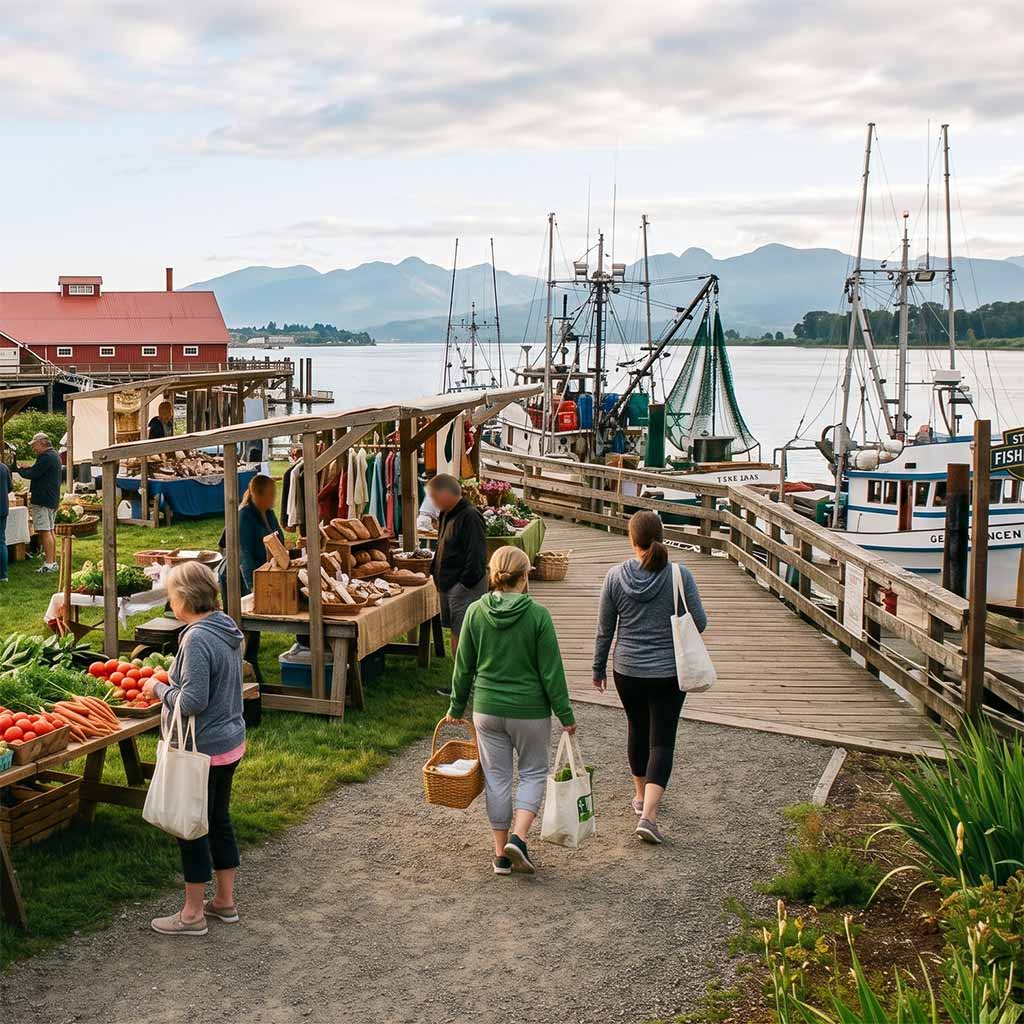
The Steveston Farmers and Artisans Market is back at Garry Point Park on Sunday, June 14, running 10:30 a.m. to 3:30 p.m. Every vendor selling at a BC Farmers Market is required to make, bake, grow, raise, or wild-harvest their product within British Columbia. That rule is the entire point. It's a direct sourcing guarantee built into the market's operating structure.
Steveston is one of the few places in Metro Vancouver where that principle has been the operating logic for over a century, not just since farmers markets became fashionable. The village was built around supply chains: fish from the water, produce from the surrounding delta farmland, goods made by the people selling them. The market at Garry Point is a continuation of that.
The Village and What It Was Built On
Steveston earned its nickname "Salmonopolis" honestly. At its peak in the early twentieth century, the village supported more than a dozen salmon canneries operating along the Fraser River, processing fish caught by a fleet that drew workers from across Asia, Europe, and the rest of Canada. The Gulf of Georgia Cannery, now a national historic site a short walk from Garry Point, is the most intact remnant of that era.
The fishing heritage is still active, not just commemorated. Steveston Harbour runs a public fish sales float where commercial fishers sell directly off their boats during season. In June, spot prawns are winding down and albacore tuna is coming into range. The logic of buying directly from the person who caught it — knowing the source, knowing the method — is the same logic the farmers market formalises for produce and handmade goods.
That sourcing chain is worth thinking about across categories. Wool, cotton, and natural latex each have an equivalent story: an agricultural origin, a processing method, a supply chain that connects the raw material to the finished product. GOLS-certified organic Dunlop latex is rubber tree sap, processed and certified through a chain that goes back to farms in India and Sri Lanka. The certification exists precisely because the agricultural origin matters. Steveston has been making that argument about fish for a hundred years.
Garry Point Park and the Market's Setting
The market is held in the southwest corner of Richmond, where Chatham Street meets the waterfront. Garry Point Park stretches to the Fraser mouth, with walking trails along the dyke and views across to the Gulf Islands on clear days. It's one of the better market settings in the Lower Mainland: open, close to the water, with Britannia Shipyards and the Gulf of Georgia Cannery walkable from the market site.
The Steveston Farmers and Artisans Market is operated by a volunteer committee under the Richmond Agricultural and Industrial Society, a not-for-profit whose proceeds support the Steveston Community Centre. The vendors must meet BC Farmers Market standards — locally produced, by the person selling. Artisans are held to the same rule: made by you, in BC.
That requirement creates a different kind of market than the generic retail experience. When you talk to a vendor at Garry Point, you're talking to the person who made or grew what you're buying. The knowledge in that conversation — about how it was made, why those methods, what the material is actually like — is part of what you're there for.
What Craft Knowledge Actually Costs
Steveston's boat building tradition illustrates a related point. The workshop at Britannia Shipyards operated for decades using a blend of Western and Japanese techniques, tools, and materials that took generations to develop. That knowledge was accumulated through practice, passed between workers, and embedded in the physical output. A boat built in that workshop is the sum of all of it.
Handmade goods carry the same weight. Four decades of making natural mattresses in this region represents the same kind of embedded knowledge: which latex densities work in which layer positions, how covers behave across different sleep patterns, what the difference between a well-made and a poorly-made Dunlop layer actually feels like. That knowledge doesn't show up in a specification sheet. It shows up in the product.
The June market at Garry Point is a good reminder of what that approach looks like at human scale. Vendors who can talk about their product because they made it, sourced it themselves, understand the material they're working with. It's not a complicated idea. It's just one the rest of the consumer economy has mostly moved away from.
How to Make the Most of the June 14 Market
Hours are 10:30 a.m. to 3:30 p.m. at Garry Point Park, 12011 Seventh Avenue, Richmond. The market runs rain or shine. Parking in the area fills up on market days, particularly in the summer; cycling in along the dyke is a reasonable option from much of Richmond and South Vancouver.
The Gulf of Georgia Cannery National Historic Site is a 10-minute walk from Garry Point. London Heritage Farm, a four-acre property documenting Fraser delta farming from the late 1800s, is close enough to combine into the same morning. If the plan is to buy off the boats at Fisherman's Wharf, the public float is a short walk from the market site and worth checking for what's available that week.
FAQs
What are the Steveston Farmers Market dates for 2026, and where is it held?
The 2026 Steveston Farmers and Artisans Market runs on select Sundays from May through September. The June dates are June 14 and June 28. The market is held at Garry Point Park, 12011 Seventh Avenue, Richmond, in the southwest corner of the city near the waterfront. Hours are 10:30 a.m. to 3:30 p.m. and the market runs rain or shine. Free to attend; vendors sell produce, handmade artisan goods, and locally caught seafood.
What's the rule about who can sell at a BC Farmers Market, and why does it matter?
BC Farmers Market vendors are required to make, bake, grow, raise, or wild-harvest their product within British Columbia. The person selling must be the person who produced it. That rule exists to protect buyers from resellers and to ensure the market functions as a direct connection between producer and customer. It's the same sourcing logic behind any product where provenance is part of the value, from wild-caught Steveston fish to agricultural-origin materials like wool, cotton, and certified natural latex.
What is still active about Steveston's fishing and seafood industry today?
The Steveston Harbour public fish sales float operates seasonally, with commercial fishers selling directly from their vessels. In June, spot prawns are winding down and albacore tuna is coming into the available range. Halibut is available from February through November. The Gulf of Georgia Cannery National Historic Site documents the industrial fishing history of the area, but the working wharf alongside it is active, not just preserved. The Steveston Salmon Festival returns on July 1, 2026, for its 79th anniversary.
If you're spending the Sunday in Steveston, Sleep Majestic is on Annacis Island in Delta, about 20 minutes from Garry Point Park. Handmade organic latex mattresses to try in person, six days a week. Fittings by appointment, call 604-731-8226 or Book a Fitting here.